Yahoo groups, blogger and Flickr provide the tools by which the group will share photographs and discuss photography. Meet-ups are encouraged e.g. an evening in a local pub to discuss photography over a pint and a bite or a photography trip to London or elsewhere. Group activities include setting members photographic challenges and assignments.

Tuesday, 17 April 2012

Has high tech killed pro photography?

From the BBC


"There seem to be cameras in everything nowadays: phones, iPads, computers, even young children's toys.
And if you want to tidy it up or create some special effect, you can do that too with the software that's around, such as Instagram which has just been bought by Facebook for $1bn.
So where does this all leave the professional photographer?
Eamonn McCabe, a portrait photographer, said that everyone is a photographer but "there will always be room for the professional, maybe not so many of us."
Technology writer Aleks Krotoski, said that while there is undoubtedly a place for professional photographers, "all content creation is experiencing an upheaval because of the web".
Eamonn McCabe said "we are all getting very lazy" when it comes to taking photographs but cameras on mobile phones were invaluable for sourcing photographs during an event such as the 7/7 bombings."


Thursday, 29 March 2012

Maurice Broomfield - Photographs of industry

Highly recommend 


Maurice Broomfield left school at 15 to work in a factory and spent his evenings as a student in the Derby College of Art. Inspired by the drama of industry, he endeavoured to convey this atmosphere with photographs and sketches, bringing an insight to those who would never experience such things. In relation to his work, Maurice Broomfield comments: "I enjoy photographing people at work, and the many experiences whilst doing this have enriched my life. To be living on this planet, is to me, the greatest gift possible."


A Fellow of the British Institute of Professional Photographers and an Honorary Fellow of the Royal Photographic Society, Maurice Broomfield has had many exhibitions in Europe. His work was exhibited in Paul Smith's Floral Street Gallery in June 2000. The designer, Sir Paul Smith, comments: "Maurice Broomfield's photography captures the real heart of what was a booming but harsh time for the UK. Finding inspiration and creativity in gritty surroundings of every day work is inspiring in itself."

Website and gallery UK. Finding inspiration and creativity in gritty surroundings of every day work is inspiring in itself."

Thursday, 15 March 2012

Snapshots of Jewish life in the UK

From the BBC a great example of photojournalism


What does it mean to be a British Jew in the 21st Century? From family life at home, to services at the synagogue - award-winning photographer, Judah Passow, set out to record the rich diversity of contemporary Jewish life across the country.


His black and white photographs are now on display at the Jewish Museum in north London. Here, Judah tells the stories behind some of the images.

Documentary Photography Course at the Jewish Museum


Date: Sunday 15 April 2012 to Tuesday 5 June 2012
Time: 2-5pm
Price: £150 including free entry to the galleries
Are you an aspiring photographer? Working on a portfolio or just taking pictures for fun? Join us for a four-week photography course and create professional shots inspired by Judah Passow’s exhibition No Place Like home.
Learn how to discover fascinating subjects, find great angles, create interesting compositions and edit your images. Led by published photographer and tutor Kevin Biderman, including a master class withNo Place Like Home photographer Judah Passow.
Sundays 15, 22, 29 April and 6 May
Bring your own camera. All levels welcome.
Places limited - booking required.
Box Office: 020 7284 7384 / admin@jewishmuseum.org.uk 


Tuesday, 13 March 2012


Photo Democracy

Launching spring 2012


Just as there are many people out there trying to find something beautiful for their walls, so there are many extremely talented photographers looking for a decent, professional outlet for their work. We know that it is incredibly hard to find galleries to exhibit your photographs - there just aren't enough. We also know that it is very hard to sell prints yourself, even harder to find a talented and experienced team to do it for you.

Photo Democracy was set up to help talented photographers circumnavigate the traditional art world, introducing them to collectors and getting their work onto walls.

Monday, 12 March 2012

Royal Photographic Society Licentiateship Handbook

RPS publishes latest version of the Licentiateship Handbook issue 5 March 2012


This Handbook, in conjunction with the Licentiateship PowerPoint Presentation has been produced to help you work towards a successful application for the Licentiateship. 


The Royal Photographic Society Distinctions are recognised as the most prestigious in the photographic world. There are three levels, the first being the Licentiateship followed by the Associateship and then the Fellowship. Although it is possible to apply directly for the Associateship most people start with the Licentiateship and work their way up through the levels and this is recommended for the majority of applicants unless you are an advanced and very experienced photographer.

Thursday, 1 March 2012

World Photo London


The Sony World Photography Awards Exhibitions and World Photo London
27th April - 20th May
Somerset House

Marking the 5th Anniversary of the Sony World Photography Awards, the beautifully curated winners' exhibitions will be on show inside the Embankment Galleries. In this vast photographic exhibition, you will find some of the best contemporary images taken by photographers from across the globe. Mixed media installations will include traditional print, video, moving image and 3D, with subjects spanning all genres, including fine art, fashion, portraiture, sport and photojournalism.
Alongside the exhibition in Somerset House, World Photo London (27th - 29th April) is returning for its annual weekend of exciting events. The programme incorporates events for anyone who enjoys photography, whether a culture buff or a practicing enthusiast, including; City Project Workshops, Business of Photography Seminar,Blurb Drop-In Workshops, Critique Sessions and Winners Tours.
Many events are FREE and students receive 20% discount on most ticketed events.

Sunday, 19 February 2012

Detroit in ruins

The Guardian has an interesting article and pictures about Yves Marchand and Romain Meffre's extraordinary photographs documenting the dramatic decline of a major American city. 


 Gallery


Article


The images are superb examples of post industrial USA  and  they give a real feel for the impact of the financial crisis, the resulting landscape is straight out of World War Two.


Devoid of people and hope. 

Monday, 23 January 2012

Lee Jeffries portraits of poverty

Have a look at the impressive black and white portraits full of emotion by Lee Jeffries. “Lee Jeffries lives in Manchester in the United Kingdom.


Images on Flikr

Tuesday, 10 January 2012

Lightroom 4 public beta is now available

Lightroom 4 


New Features in Lightroom 4 Beta

  • Highlight and shadow recovery brings out all the detail that your camera captures in dark shadows and bright highlights.
  • Photo book creation with easy-to-use elegant templates.
  • Location-based organization lets you find and group images by location, assign locations to images, and display data from GPS-enabled cameras.
  • White balance brush to refine and adjust white balance in specific areas of your images.
  • Additional local editing controls let you adjust noise reduction and remove moiré in targeted areas of your images.
  • Extended video support for organizing, viewing, and making adjustments and edits to video clips.
  • Easy video publishing lets you edit and share video clips on Facebook and Flickr®.
  • Soft proofing to preview how an image will look when printed with color-managed printers.
  • Email directly from Lightroom using the email account of your choice.

Saturday, 31 December 2011

Photographs are connected to the physical world

An interesting and thought provoking video from the Guardian

Errol Morris: 'We've forgotten that photographs are connected to the physical world' - video

Writer and Oscar-winning documentary maker Errol Morris talks about the nature of truth, art and propaganda in photography. Drawing examples from the photographs of Abu Ghraib and the Crimean war, cited in his book Believing is Seeing, he argues we've often underplayed the link between photgraphs and the physical world

Tuesday, 27 December 2011

Post-processing in the digital age: Photojournalists and 10b Photography

From the British Journal of Photography


10b Photography has established itself as one of the world’s leading digital darkrooms, handling post-production for scores of award-winning photojournalists who trust that the company knows where to draw the line between processing and manipulation. Olivier Laurent meets the founders.


Post-Producer
10b is a digital darkroom and, for all intents and purposes, works similarly to an old-fashioned darkroom. "The recent introduction of the raw shooting format has enabled digital photography to share a very similar workflow than with analogue photography," says 10b on its website. "Just like a negative, a raw file cannot be printed the way it is and needs to be ‘developed' first. Contrast, saturation and hue, for example, have to be set during the editing process. This step takes the name of ‘raw conversion' and, with the exception of chemicals, it resembles the developing process of a film."


continue reading article 

Sunday, 4 December 2011

iPhone 4S v pro camera - in pictures


From the Guardian

"iPhone 4S v pro camera - in pictures

Recently Annie Leibovitz recommended the new iPhone 4S as "the snapshot camera of today". Photographer Katherine Rose put the phone's camera through its paces to see how it would fare in comparison with the Canon 5D mkii she uses profesionally"

Saturday, 3 December 2011

Top tips: Photographing your area

From the Guardian 


Photographer Alicia Canter gives her top tips on how to take pictures of your local area


"Plan
Plan your trip before you go out, is there somewhere in particular that would make good photos? Think about what your area is about and what kind of things could represent that visually. Make a list and prepare!
Time of day
Think about the time of day that you want to shoot your area in, would it be more atmospheric at night with Christmas lights and reflections in the shop windows? Or is it more alive in the day or at the weekend? You can always include a mixture. Think about it as though you're shooting for a glossy magazine or a feature about the place where you live.
Equipment
If shooting at night remember to take a tripod – and a flash if you're going to do close-ups. Think about the kind of lens you will need too, I used a 100 for close-ups and a 16-35mm wide angle for the general shots.
Talk to people
People are a valuable insight for the viewer – it's important to include some human presence in the pictures. If you live near a market and want to photograph the stallholders, or want to take pictures of people drinking coffee outside cafes, ask them first – people will usually say yes.
Focus in
You could focus on just one part of your area if it's diverse enough to create a six-picture story.
Capturing movement 
This conveys the feeling of a busy environment. Remember to take a tripod, use a slow shutter speed and be patient when you've set up your shot – it won't happen instantly.
Dynamic
Think about how to make your pictures interesting. Try different angles, use the environment (railings, cobbled streets, etc) to help lead the viewer's eye into the picture.
Go back
If you don't think your set is finished after your first outing, don't be afraid to go back again. This is good practice and allows you time to reflect on your pictures and improve them – you have a whole month to get the assignment right, don't be afraid to use it.
Adding glamour
If you want your pictures to show the best possible (and slightly more glamorous!) view of your area, post production is important. You can adjust your levels and curves to bring the contrast up, and oversaturate the images slightly. Burning in the edges of your pictures to help the draw the viewer in to it. All of these are things that could've been done in the darkroom.
Timeless
Try to make your pictures timeless, good stock or travel photographyshould be useful all year round and have a long shelf-life.
"

Monday, 28 November 2011

A challenge water droplets

Inspiring images from Heinz Maier Stuttgart germany


"I’ve been photographing since the end of 2010. I'm fascinated by everything in the photography I would really like to try everything at once but one after another. I do not know yet which genre I would be developing in, but right now I am experimenting in macro photography (insect and water drop photography).I photograph in my free time; that is the best way for me to relax."


Friday, 25 November 2011

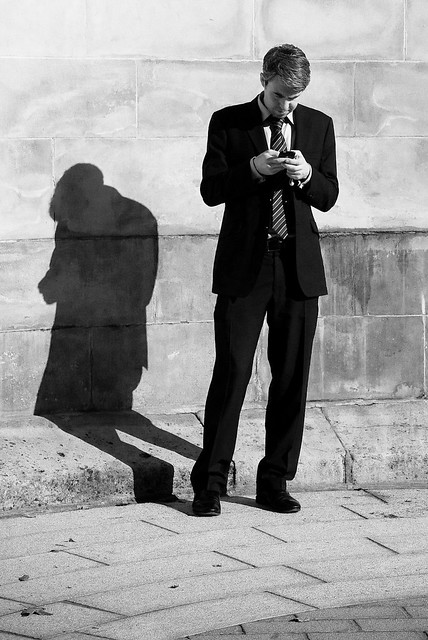
Crack-Berry a modern addiction

Crack-Berry a modern addiction

I shot this image  in the City of London. I like the way the shadow kneels and looks as though its in prayer


A  video of  Bob Turner FRPS judging this image  Malden Camera Club  projected image competition - 24/11/11


David Sillitoe's 24 hour narrative Guardian staff photographer David Sillitoe discusses his approach to shooting this month's camera club assignment

From the Guardian


"A photographic narrative is simply a story told with pictures, and can be journalistic (for example a photo essay), artistic and/or abstract, or simply function as entertainment.
The word narrative derives from the Latin verb narrare, to recount, and is related to the adjective gnarus, meaning knowing or skilled. Owen Flanagan of Duke University, writes: "Evidence strongly suggests that humans in all cultures come to cast their own identity in some sort of narrative form. We are inveterate storytellers."
So where does this leave this months assignment: "Your camera club mission this month is to document 24 hours of your life in six images." This is one of those briefs that initially seems quite simple, but the more you think about it, the harder it is to pin down, and to make some kind of sense of. Of course one could approach this in a simple and literal way; the 24 hours could be documented as a linear timeline, starting when one awoke, and ending with sleep.
As Lee Welton succinctly summarized on the Flickr thread, his day is simple:-
Coffee; Train; Work; Train; Dinner; Bed
Each of these could be an image, and that approach would certainly work, added to which, I'm sure Lee is being modest, there'll be more to it than that!
As an aside, there is no requirement to use the full 24-hours for this, it can be any amount of time you choose. But the temporal approach is one choice of several; an examination of place is just as valid; unless you're immobile (or choose to be), you'll certainly move around within a day. To counter that, it would be possible to tell a story, and not even leave your chair. So, if we dismiss those contrived self portraits which rarely work, what is it that we can actually make pictures of? My 6 images are were made over a morning, where I got up, did some work in my house, and watched part of a scary movie, which to a degree informed the aesthetic of the photography."

Tuesday, 22 November 2011

My new camera for street photography

I have in the past used a Canon 40D for street photography. Being a large DLSR the Canon 40D tends to be too obtrusive , I am fortunate therefore to have been given a Olympus XZ-1 compact camera as birthday present.


 A big plus is the fast f 1.8 lens and good low light performance and its so much lighter than the Canon 40D.  A priority is to compare image quality with the Canon 40D by printing at A3


 I cant wait to go out and give it a test. The first opportunity will be the demonstrations by civil servants in London on 30th November 

Friday, 18 November 2011

Amateur street photography: a beginner's guide

From the Guardian

Amateur street photography: a beginner's guide


Camera Club member and photographer-about-town John Carvill explains how to capture great street scenes – and why they're worth it despite the perils of the pavement

Picture the scene: you're out on the sidewalk – maybe shopping, chatting or just daydreaming. Suddenly, you notice a shifty-looking bloke pointing a camera at you. What's your reaction? Discomfort, embarrassment – anger?

Before you lose your temper, spare a thought for the person behind the camera. As a practitioner of the increasingly popular art of amateur street 
photography, I can assure you there's every chance the photographer is feeling as embarrassed as you, and is just as uncomfortable with the idea of invading your privacy.
So why do we do it? Are we just voyeurs and stalkers out to spy and gawk? Well, no, but these assumptions mean we're often in a precarious position. Perhaps our most compelling excuse is the chance to make something out of nothing, to preserve or even celebrate a fleeting moment that barely existed and yet contained something special – a look, a feeling or just a random assembly of shadows and shapes.
We talk about "taking" a photograph, but the process is nowhere near as one-sided as the word implies. There's a crucial exchange between a photographer and the one-off moment they seek to capture. The moment was already happening and yet, at the same time, was also brought into existence by the photographer – it wasn't fully there until it was recorded. It's like taking a scalpel to the flow of the street and slicing off a fragment, which becomes something more than it was. There's a kind of drama to the act.
City streets are a great place to take photographs. Even mediocre shots can capture something of the energy and romance of communal life. It's no wonder that street photography is enjoying a renaissance. You may have noticed people pointing cameras at strangers in the street, or perhaps you're tempted to try your own hand – either way, Thames & Hudson's recent anthology Street Photography Now confirms its increasing popularity.
For those who yearn to make the leap from admiring other people's photographs to photographing other people, street photography is the obvious starting point. But it presents a challenge: you only get one chance to capture each moment before it's gone; there are no second takes. The advantage is that there are an infinite number of these moments.